 OctoView Labs
Can your system testify?
This is my AI development substrate watching itself work. Live.
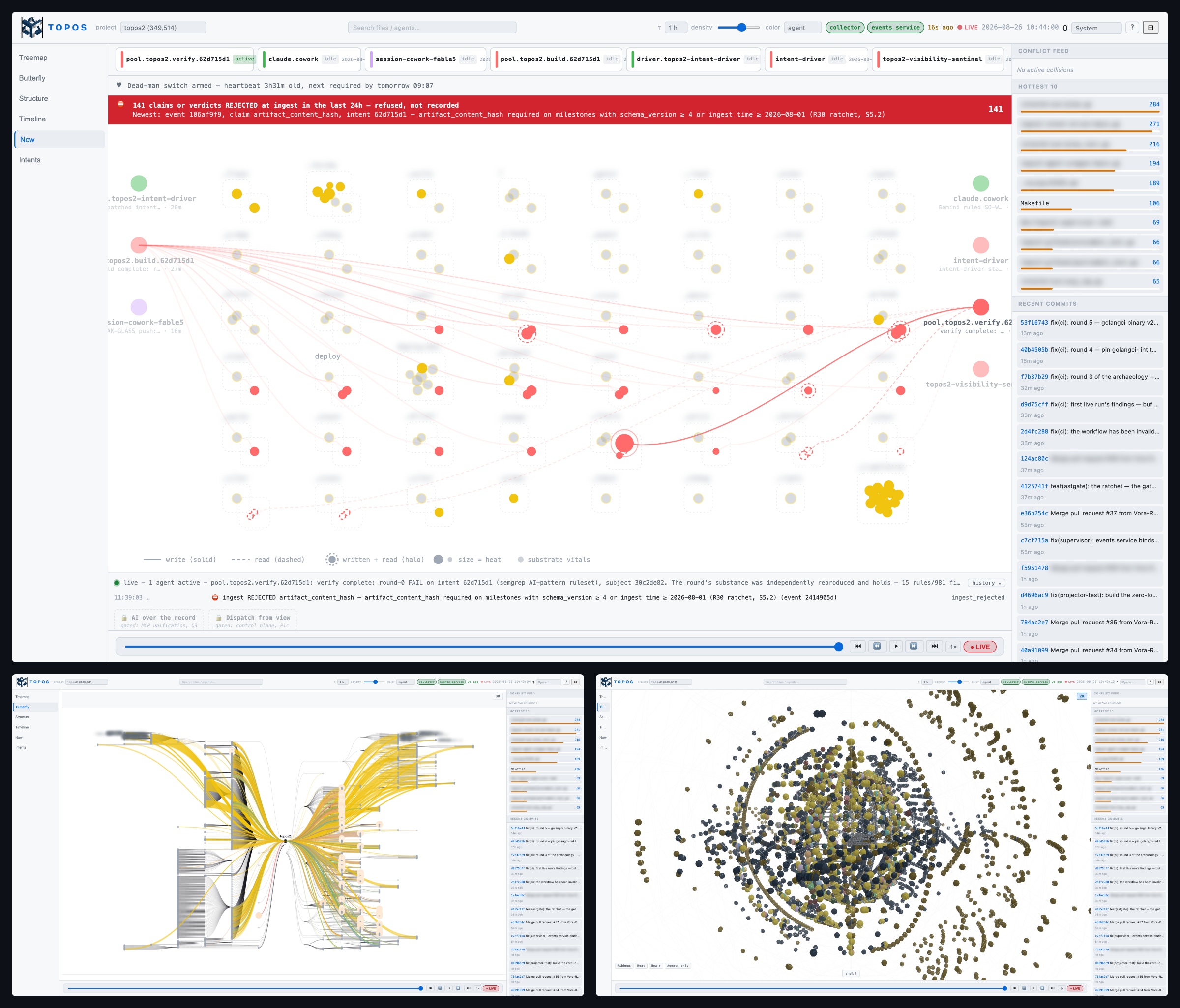
The MAP: every dot is a file my agents touched in the last hour. Solid lines are writes, dashed are reads. The named badges across the top are the agents themselves: a build worker, a verify worker, the dispatcher, me.
The BUTTERFLY: the whole codebase spread as two wings, every golden ribbon an agent's hand moving through it this week.
And the part I'm proudest of is the red banner: my own system telling me about 141 facts it REFUSED to record in the last 24 hours: claims that couldn't prove what they asserted, refused at the border, quarantined recoverable. 141 rejected facts today isn't a system failure. It's 141 times our invariant engine caught an agent hallucination before it could corrupt the ledger. Most systems hide their losses. Mine is contractually required to confess them.
Under this screen: the guardrails are constitution-locked against the very agents that work beneath them, a completion claim without a content hash is refused at the keyboard, and every design faces an adversarial tribunal whose verdicts are permanently anchored in the ledger before I even review them. When my agents built something clever this week, five independent reviewer agents voted 3 to 2 to REJECT it. The rejection is in the ledger, and the mechanism stayed out of the codebase until it earns its way in. Every commit in that feed traces to a signed approval.
Everyone will have self-building AI systems within a year. In regulated industries, the question won't be "can your agents build?"
It will be: can your system testify?